
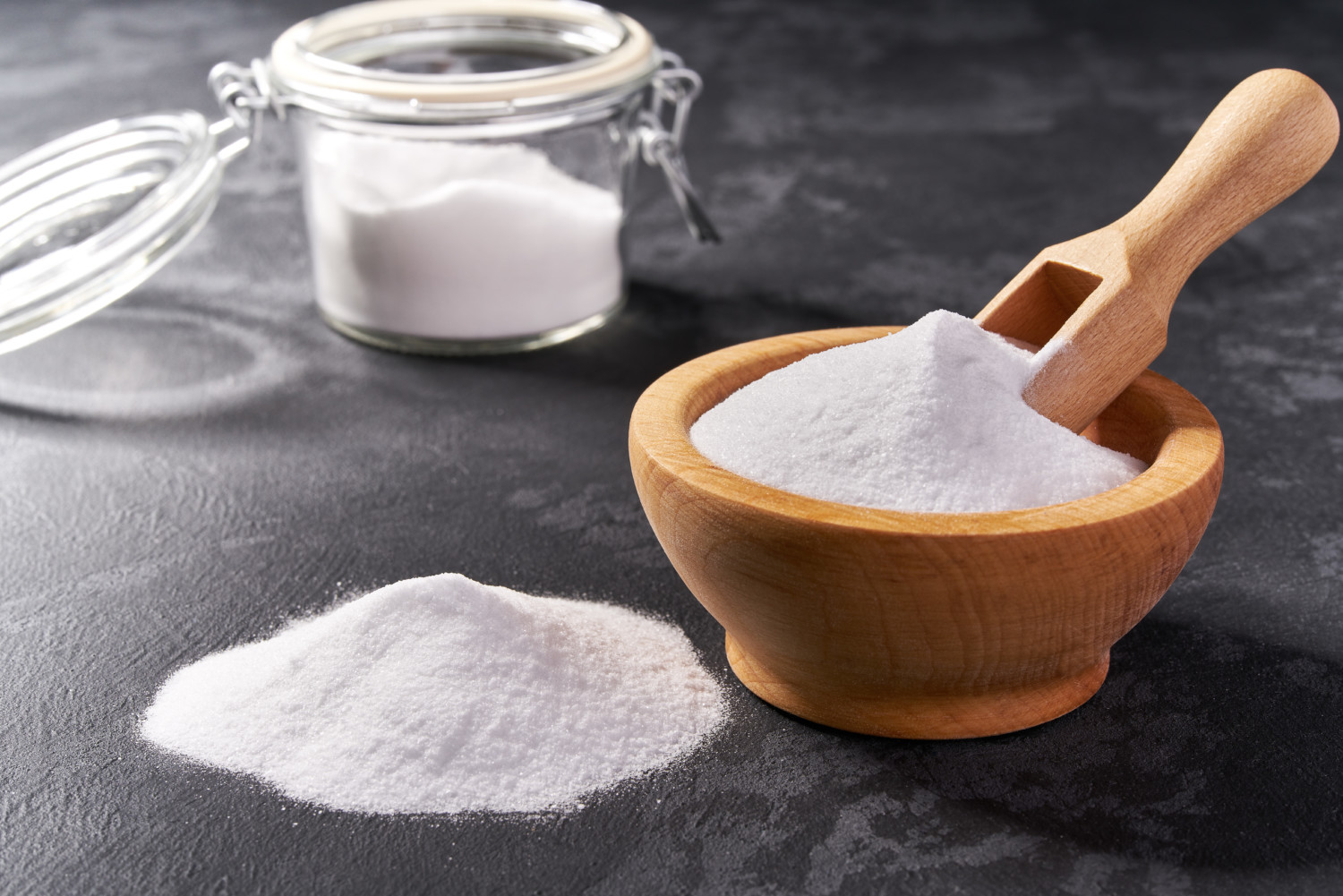
Sodium Bicarbonate aka Bicarb aka Baking Soda (NaHCO₃).... depending on where in the English speaking world you live in, it goes by different names.
This magical powder has literally hundreds of uses both personal and industrial.
First, let's talk about his bully of a cousin, Washing Soda. Make sure you don't ever confuse Baking Soda with Washing Soda... while related they do not have the same applications. Much the same as Michael Angelo and Bob's Painters do not have the same applications.
Washing Soda is more powerful and a lot more caustic.
Washing Soda aka Soda Ash aka Sodium Carbonate (Na2CO3) is very basic... as opposed to acidic that is (look in the PS down below for a detailed explanation of acids vs bases).
It is able to burn, destroy and damage organic tissue. It is NOT edible and can damage eyes and skin. It is made simply by baking Baking Soda at a specific temperature for a specific time. This process turns simple, healthy Baking Soda into a mad abrasive cleaner that can actually scratch surfaces.
Usually, it is best to use bases to clean acid stains and most household stains are acidic. Baking Soda has the pH of 8 and Washing Soda is all the way up to 11 pH.
Washing soda is better at dissolving grease, but also at dissolving your skin, so be careful. It is also an honored member of many laundry powder recipes... but not too much, because it's a bully of a cleaner and can damage delicate fabrics.
The whole cleaning game hinges on the pH of the water. You want to raise the pH a little but not too much because then things just slide around and you are left with a grimy film on everything you are trying to wash.
Use Washing Soda for sturdy surfaces that need deep cleaning and will not be damaged (also, are not absorbent). Use Baking Soda for cleaning around children and natural surfaces. Baking Soda is a great all-around cleaner, I have a shaker filled with it near my sink in case a frying pan or the counter need extra scrubbing action (when I want the action to be antibacterial I add a few dashes of rubbing alcohol on my cloth).
There is more.... You can use Baking Soda as:
 A carpet deodorizer - when you mix some baking soda with a few drops of essential oils and sprinkle it all over the carpet a few minutes before vacuuming.
  A deep body or teeth scrub - mix baking soda with some salt and oil to make a paste - it can be liquid coconut oil, olive oil or any other oil that is edible - use as a whitening scrub on your toothbrush or use it on your skin in the bath. (Why edible? Because your skin is your biggest organ and you should try not to put things on there that are not edible... with soap being an exception for some people. All soaps are not created equal either, find one that is non-toxic to protect your body from long term damage.)
*** WARNING ***
Every time you use oil in the bath make sure to wash the bathtub as it can make your tub ultra slippery and that can be like a trap to your housemates.
***
A baking additive to add volume to cakes, pancakes, and waffles - use in conjunction with an acid to activate (ie. Add lemon juice, buttermilk, yogurt, etc to activate the bubble forming magic of Baking Soda). pH adjuster and effervescent - in some industrial food applications, it is used as a pH adjuster or effervescent for products like instant noodles, soft drinks and energy drinks. Even some crackers and potato chips have it added as a balancer of acidity.
According to IHS Markit, it is used in the following industries:
- Animal feed
- Food
- Hemodialysis
- Chemicals
- Cleaning products
- Flue gas desulfurization
- Water treatment
- Pharmaceuticals and personal care
- Blast media
- Fire extinguishers
Heartburn remedy... yes! Acid reflux is a pain, but put down your aluminum filled tablets. Baking Soda is a one ingredient solution that has no side effects. We mentioned the tooth scrub, which is what I use for my teeth, but for deeper cleaning, you may also want to mix up your own alcohol-free mouthwash using salt and baking soda for their antibacterial action.This mouthwash will also assist in getting rid of canker sores and other mouth infections.
Air freshener - yes! Baking Soda absorbs odours... odours in your fridge, odours in your shoes and odours in your car. It is a safe and effective alternative to scary commercial air fresheners and it can always be mixed with essential oils for an extra boost of scent at the right time. A fruit wash. Some people use vinegar but you can also use baking soda to wash your fruits and veggies and remove any nasty residue that might be left on the skins of your favourites.
One study found that soaking fruit in a solution of Baking Soda for 12-15 min removed nearly all traces of pesticide.
There are hundreds more uses but I will leave you with these most common ones... maybe if you find something else that you do with Baking Soda that is amazingly life changing do drop me a comment or send me an email so that I can also improve my life with your invention.
Agnieszka
PS. Let's talk for a minute about the concept of bases vs acids.
One of the source articles from Bren I used for this report has this explained perfectly well, so I will just copy her explanation here while linking the original article here.

PH LEVELS AND CLEANING
We have to step back to high school chemistry class to continue examining the difference between baking soda and washing soda. Remember the pH scale?
The pH scale is used to determine if a liquid is acidic, basic, or neutral.
The scale runs from 0 to 14, the center of the scale is neutral (number 7).
Solutions from 0-6 on the scale are acidic.
Solutions from 8-14 are basic.
The further away from 7 you move on the scale, the more intense the acid or base.
Substances at the ends of the scale are caustic (able to destroy organic materials/cause chemical burns). For example, battery acid has a pH of 0 and drain cleaner has a pH of 14.
Each whole pH value is ten times more powerful than the next whole value. For example, pH 10 is ten times more alkaline than pH 9 and 100 times more alkaline than pH 8.
When a base is added to an acid (or an acid added to a base), the solution moves toward the middle of the pH scale as it is partially or fully neutralized.
